
Unlike in the past, Modi made candid, frank and direct remarks on his hosts by suggesting that the Chinese side is holding back on further improving relations, says Srikanth Kondapalli.
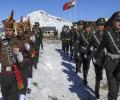
The MEA spokesperson did not reply to questions like whether the US had approached India with the offer, whether New Delhi has communicated its response over it to Washington, DC or whether the Trump administration has been briefed about the current standoff between Chinese and Indian soldiers in eastern Ladakh.
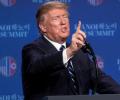
Trump also announced that the US will end special treatment of Hong Kong in response to Chinese imposition of new controls.

China on Monday said Indian Prime Minister Manmohan Singh's three-day visit from Tuesday is of great importance for deepening strategic partnership amid expectations that the two sides would sign some key pacts, including one to prevent incursions along the LAC.

United States Vice President Joe Biden arrived in Beijing on Wednesday for meetings with top Chinese leaders amid an international spat over China's new air defence zone over the disputed islands in the East China Sea.

This is the first time such a bilateral dialogue focusing on Central Asia where the two countries have long and historical ties was held, reflecting deepening diplomatic engagement between the two neighbours even as they try to sort out friction resulting from recent reported incursions by Chinese troops along the Ladakh border

For a rising country like China with its sights set on global and regional power, any coming together of the US and India is the worst case scenario. Hence, China is concerned with the emerging equations between New Delhi and Washington, says Srikanth Kondapalli.

China, however, remained ambiguous about the status of its own troops.

Modi was expected to arrive in Wuhan in the evening on April 26 and join Xi in the informal summit at a picturesque location the next day.
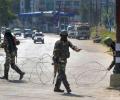
The battle to manage the international environment over Kashmir has just begun, but what is expected to help is the lifting of internal controls. All eyes are now on that exercise. Aditi Phadnis reports.

In a rare gesture, China's official media in Beijing on Tuesday extended its biggest coverage to an Indian political event projecting Narendra Modi's takeover as Prime Minister as a harbinger of "big boost" to China-India relations.

In a diplomatic breakthrough, Chinese President Xi Jinping and Japanese Premier Shinzo Abe on Monday held their maiden talks, marking the "first step" towards mending ties between the two Asian rivals after years of territorial disputes and animosity due to wartime history.

Mukherjee extended an invitation to Xi to visit India which he accepted.

'India has ramped up infrastructure on its side, so the Chinese military is finding Indian soldiers in locations where they are not used to seeing an Indian footprint,' points out Harsh V Pant.

India and China on Tuesday discussed the recent spate of incursions and ways to maintain peace and tranquility along the Line of Actual Control in the border areas.

Without naming Pakistan, he said there are some who are trying to project an 'alarmist approach' to the situation in Kashmir, which is far from the ground realities.

The two countries sealed 10 agreements, including the much-publicised transit trade treaty which will end Nepal's total dependency on Indian sea ports for third-country trade.

Terrorism is a snake that bites the hand which feeds it: India to China

The PM on Tuesday officially announced his visit to China from May 14 to 16.
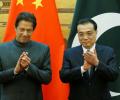
In recent years, China has refrained from taking a public stance on the India-Pakistan ties, expressing hope for resolution of the disputes through dialogue.
However, Beijing expresses readiness for talks to reopen the Nathu La pass for the Kailash-Mansarovar Yatra.
According to the amendment adopted by nations, developed countries will reduce HFCs use first, followed by China along with a large number of countries.

The two leaders enjoyed the sunshine with a walk in the grounds of Schloss Meseberg, an 18th century Baroque castle in the Brandenburg district of Germany.

Prime Minister Narendra Modi on Thursday had his first meeting with Chinese Premier Li Keqiang, who said that China is looking forward to the Indian leader's maiden visit to Beijing.
'Tibet remains a prickly issue between the giant Asian nations. China still claims more than 80,000 sq kilometres of Indian territory in the Northeast. Why? Just because Beijing refuses to acknowledge the McMahon line which separates India and Tibet, and this, simply because the 1914 Agreement delineating the border was signed by the then government of independent Tibet with India's then foreign secretary (Sir Henry McMahon),' says Claude Arpi.

The G20 chair has suggested three areas for the talks in Argentina - the future of work, infrastructure for development and a sustainable food future, areas where India has a lot at stake.

'It will be foolhardy to overlook that this stunning shift in China's stance comes as the culmination of the severely damaged India-China relationship under the present government,' says Ambassador M K Bhadrakumar.

India and China have not ruled out a Modi-Xi meeting during the summit.

But Modi and Xi will attend a BRICS leaders meeting in Hamburg.

China on Wednesday warned that it will take "necessary measures" to defend its territorial sovereignty and interests after India "obstinately" allowed the Dalai Lama to visit the "disputed" parts of Arunachal Pradesh causing "serious damage" to the bilateral ties.

There are still a few lingering issues towards the progress of India-China bilateral relations, the approach for dealing with each other seems to be quite different. With Modi-Xi bonhomie strengthening, it seems that India and China are ready to recalibrate their approaches towards each other, says Sana Hashmi.
In the two-day summit, the SCO will kick off the process of India's accession to the grouping as a full-fledged member along with Pakistan.

India and China on Friday agreed to seek a "political" solution to the border dispute at the earliest as Prime Minister Narendra Modi asked Beijing to "reconsider its approach on some issues" and announced CBMs like e-visa for Chinese tourists and operationalisation of hotline between two militaries.

Talking about the threat of terrorism, he said "As diverse and pluralistic societies, we both face threats from fundamentalist terrorism. Yet, we do not seem to be able to cooperate as effectively we should in some critical international forums dealing with this subject."
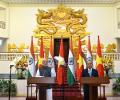
India on Saturday extended $500 million (Rs 3,328 crore) Line of Credit to Vietnam for facilitating deeper defence cooperation with the south east Asian nation, as the two countries elevated their ties to a Comprehensive Strategic Partnership to respond to emerging regional challenges.
Playing down President Barack Obama's visit to India, official media in Beijing on Wednesday said too much need not be read into the "romance" between him and Prime Minister Narendra Modi as there are difficult talks ahead before both sides' expectations can converge.

External affairs ministry spokesperson Raveesh Kumar said India does not comment on the internal affairs of other countries and similarly expects other countries to do likewise.
.jpg)
Both India and China have demonstrated levels of maturity in diffusing tensions and ensuring that the border remains by and large incident free, says Seema Mustafa
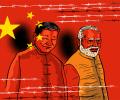
The reasons for China's negative response are located in its territorial dispute with India but also to its grand designs of dominating the region from its previous position of being merely a "balancer" between India and Pakistan, points out Srikanth Kondapalli, Professor in Chinese Studies at JNU.

In an interview with Larry O'Connor, Pompeo said in his meetings with his counterparts from Japan, India and Australia, they began to develop a set of understandings and policies that can jointly take these countries to work to present a true resistance to the threats that the Chinese Communist Party poses to each of these nations.
